
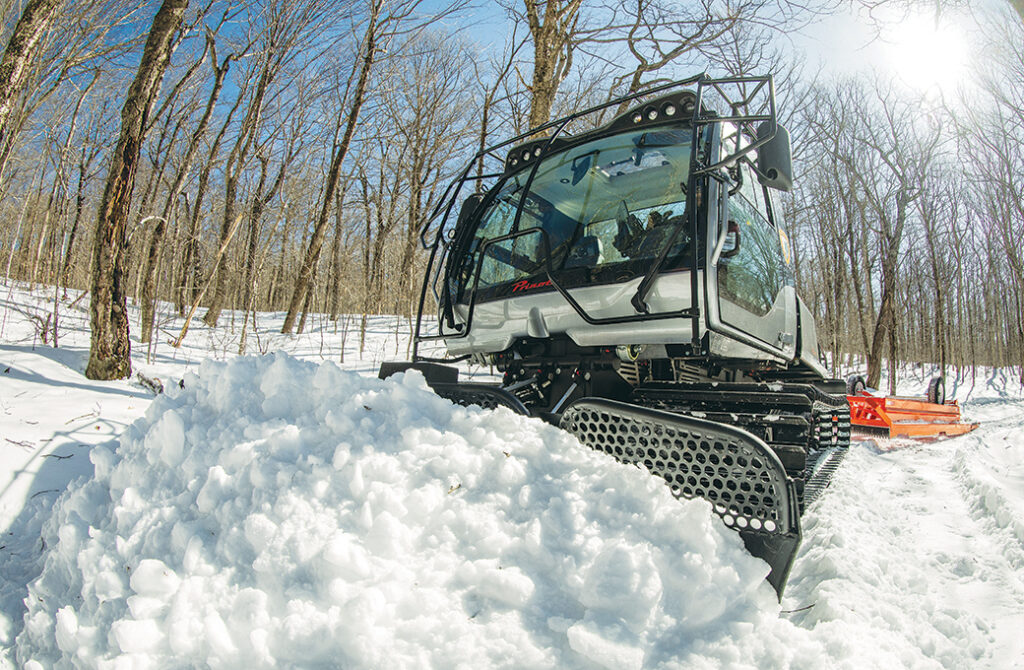
When a snowmobile club orders a new Prinoth groomer, they get to pick their preferred steering interface: a steering wheel or “stick” / lever controls. The choice may feel subtle on paper, but in practice it can affect control, ergonomics, operator fatigue, and how intuitive the machine feels. In this article, we explore the pros and cons of each steering mechanism, which can be used as a conversation starter with your club before you buy your next machine.
Steering in Snow Groomers
Before we dig into the pros and cons, a bit of context:
• Snow groomers are driven by hydrostatic hydraulic systems, with each track (left and right) driven independently. Steering is achieved by differential track speed (one track moving faster/slower relative to the other).
• Whether you use a steering wheel or levers, the operator’s inputs get translated into hydraulic commands to modulate flow/pressure to track drive motors.
• Many modern groomers (including Prinoth’s) support “cruise” or fixed-RPM modes, decoupling speed control from steering input, which changes how the two steering styles feel.
With that in mind, here’s how the two steering philosophies compare.
Steering Wheel Advantages
1. Familiarity & Intuitive Feel
Many operators are already accustomed to steering wheels (cars, trucks, tractors). Turning left causes left, turning right causes right — the mental model is simple.
This can shorten the training curve, especially for operators coming from wheeled steering backgrounds.
2. Precise, Low-Effort Fine Adjustments
With a well-tuned hydraulic assist / power steering system, small corrections can be made with minimal effort.
3. Excellent for Holding a Line
For long straight runs or slow transitions, the wheel allows the operator to “steer into” a trajectory gently, holding a heading with minimal input.
Wheel Challenges
1. Less Direct Feel / Response
Because the wheel is an indirect interface (turn wheel → controller → hydraulic system), there can be a lag or damping. In soft, uneven snow, that “buffer” might reduce responsiveness compared to direct lever control.
2. Mechanical Limits
You can’t spin the wheel infinitely; the mechanical travel may be constrained. In tight turns or sharp adjustments, one may reach the stopping point of the wheel.
3. Complexity & Maintenance
More mechanical parts (steering column, bearings, linkages) may increase maintenance or susceptibility to wear.
4. Cognitive Disconnect in Some Conditions
Some operators feel that a wheel doesn’t “feel like a machine” — they lose the visceral connection of direct control.
Steering Levers / Sticks
In this style, two control levers (one for each track) are pushed forward or pulled back, either independently or in a coordinated fashion, to modulate speed and direction.
Advantages
1. Very Direct, Responsive Control
Because each lever directly controls forward/back pressure to each track, the operator often enjoys heightened sensitivity and responsiveness. Track differential is more directly manipulated.
2. Aggressive Maneuvering & Tight Turns
In tight terrain or steep switchbacks, the operator can apply more aggressive differential commands (e.g. holding one lever slightly back, the other forward) in an instant. This can aid sharper turning, pivoting, or tight track corrections.
3. Good for Experienced Operators
Those who “feel” the machine often prefer sticks — it gives them the leverage and responsiveness they want. Many long-time groomer operators see stick cats as more precise or connected.
4. Simplicity & Robustness
Fewer parts in the mechanical linkage of steering (no steering column, less complex joints) mean less to maintain or calibrate. In cold, vibration-heavy applications, this can be an advantage.
Challenges
1. Higher Learning Curve for New Operators
For someone not familiar with dual-stick steering, coordinating smooth curves without jerky transitions can be tricky. Operators may overcorrect, producing “zig-zag” behavior.
2. Operator Fatigue / Arm Strain
Holding and moving the levers continuously, especially on long shifts or rough terrain, can strain the forearms or shoulders more than a wheel movement might.
3. Less Natural for Straight-Line Holding
Maintaining a straight path may require continuous micro corrections — the operator can’t “rest” a hand on a wheel and drift slightly.
Which One Fits Best for Your Operation?
Here are factors to consider when selecting your steering style on a groomer:
1. Operator Profile & Experience
If your operator pool includes many who have driven trucks, tractors, snowmobiles, etc., wheel steering may seem more accessible. If you have veteran groomers used to stick cats, lever style may feel more natural.
2. Terrain & Grooming Strategy
In tight, technical terrain (steep gullies, tight switchbacks, narrow trails), the extra responsiveness and sculpting capacity of levers can shine. For long, open trails, wheel control may allow smoother straight lines and reduce fatigue.
3. Maintenance Philosophy
If you prefer fewer moving parts, simpler calibration, and a robust setup, levers may offer lower long-term maintenance overhead. However, both systems in modern Prinoth groomers are built to high durability standards.
Wheel or sticks? There’s no wrong answer!
At the end of the night, it’s more about the operator’s preferences than anything else. We recommend that clubs discuss the pros and cons, then get in a demo machine before they decide. There is a learning curve in all grooming operations, and sticks might just be the answer for your club. ν